Peptides are everywhere in science today, from metabolism studies to skin and longevity research. But what actually sets a peptide apart from a protein, and why do so many research groups work with them?
Definition
A peptide is a chain of amino acids joined by peptide bonds. There is no strict cut-off, but chains of up to about 50 amino acids are generally called peptides; longer ones, proteins.
Size matters: peptides are small enough to be produced by chemical synthesis and large enough to bind to receptors with high specificity.
Peptides as signals
In the body, many peptides act as messengers. Insulin, GLP-1, oxytocin and growth hormone-releasing hormone (GHRH) are examples. Each one fits a specific receptor and triggers a response in the cell.
That specificity is what makes peptides interesting for research: it is possible to study one biological pathway with little interference in others.
How they are made
Most research peptides are made by solid-phase peptide synthesis (SPPS), the technique that earned Bruce Merrifield the Nobel Prize in Chemistry in 1984. Amino acids are added one by one onto a resin, in sequence order. At the end, the peptide is cleaved, purified by HPLC and lyophilized.
Each coupling step has a small failure rate, so long peptides are harder to produce at high purity. We explain how purity is measured in what 99% HPLC purity means.
Main research areas
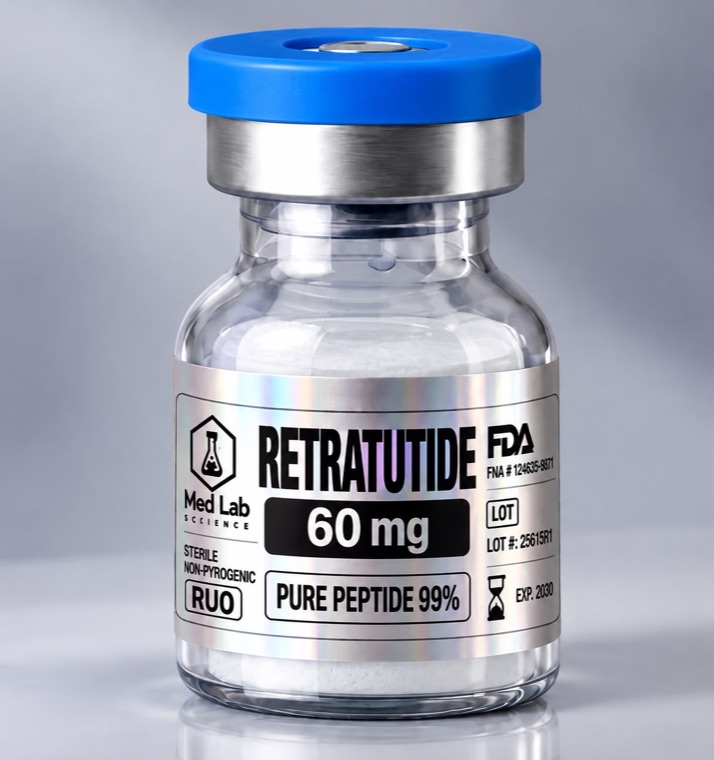
- Metabolism: incretin agonists such as tirzepatide and retatrutide, and the mitochondrial peptide MOTS-c.
- Tissue repair: BPC-157 and TB-500, studied in tendons, muscles and wound healing in animal models.
- Skin and collagen: GHK-Cu and copper analogs.
- Growth hormone axis: secretagogues such as ipamorelin and CJC-1295.
- Cognition and sleep: Selank, Semax and DSIP.
- Longevity: Epithalon, NAD+ and SS-31.
Research peptide vs. medicine
A peptide sold for research has not gone through the approval process of a medicine. Some molecules, such as tirzepatide, exist in both forms; others are still under study. Med Lab Research products are reagents intended exclusively for laboratory research.
See the full line in the catalog.